The Twilight of Chatbots: Why Your AI Workflow Is Already Obsolete
You stopped being surprised by what seemed like science fiction yesterday. We are inside an exponential curve, and the real shift is not in the models, but in how we work with them. From dialog with chatbots to managing agents, from prompt engineering to domain expertise.
A few years of working with AI produce a strange effect: you stop being surprised by things that should surprise you. Another leap in capability, another round of “now the model can do what seemed like science fiction yesterday,” another headline about some agent completing a task that would have taken a human weeks. Instead of wonder, you feel only the fatigue of having to relearn everything.
But if you stop and look at the trajectory, the picture is unusual. We are living inside an exponential, and that is the main reason AI constantly feels like a series of disjointed shocks rather than smooth progress. Each fixed interval of time delivers a larger leap than the one before it. A model that a year ago could work for a couple of hours with a high error rate today delivers sixteen hours of autonomous work from a single prompt. A plan written last winter already describes a different reality. This is not a hypothesis. It is what you encounter every day if you use AI for real tasks.
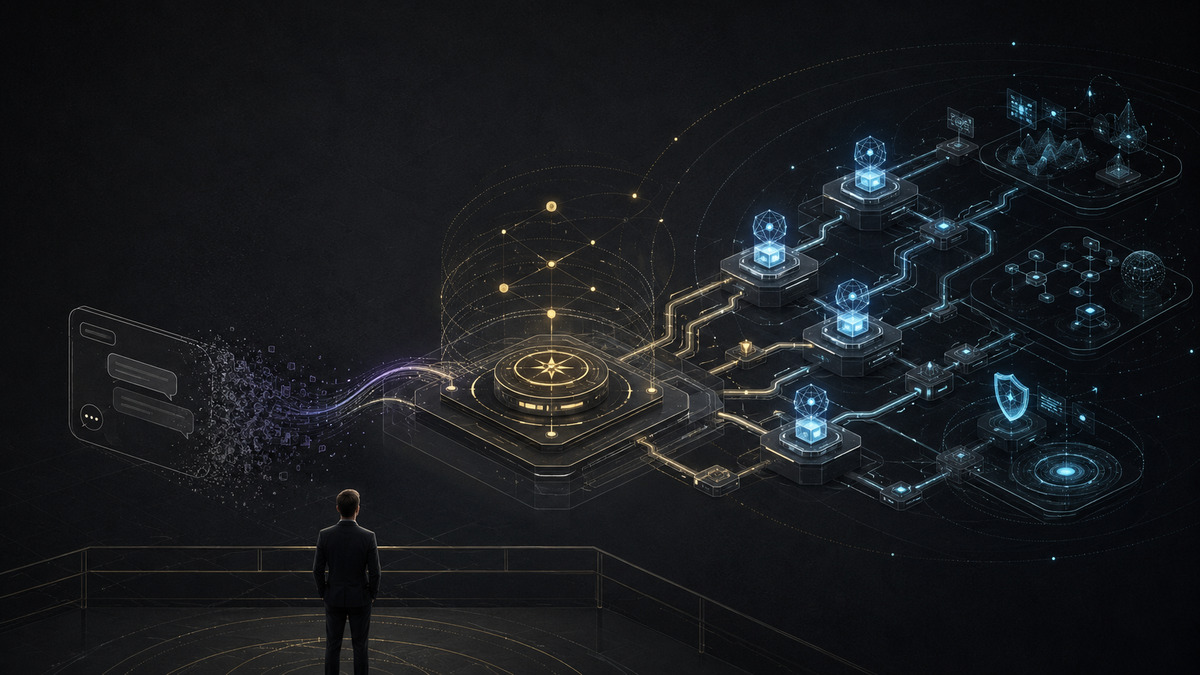
The most interesting thing, in my view, is not happening at the model level, but at the level of how we work with them. For a long time, the dominant pattern was co-intelligence: you ask a question, check the answer, correct it, move on. Human in the loop, step by step. This approach has not disappeared, but it is no longer the main way to get value. Increasingly, work looks less like a conversation with a chatbot and more like managing agents. You do not discuss every step with the AI. You set a task, give it tools, and let it run for hours, sometimes days.
This is a fundamentally different skill. It requires not the ability to formulate prompts, but the ability to set objectives, decompose goals, and verify results from a distance. Essentially, a management skill in its pure form. And here an unexpected thing emerges: profession stops predicting success. A lawyer who has never written code turns out to be no less effective working with an AI agent on legal tasks than a programmer working in an unfamiliar domain. Expertise in the subject matter is what matters. Not mastery of the art of prompting.
The data confirms this. A separate study of Claude Code users showed that it was not profession that determined success, but the depth of domain expertise. The better a person understood the task, the more useful output they got from each prompt. And this worked equally across all professions. A software engineer handled an unfamiliar task with the same success as a lawyer or an HR specialist in their own domain. Expertise beat title.
I notice this in myself as well. Over the last six months, I talk to models less and less and distribute work among them more and more. One agent collects and analyzes job vacancies, another writes drafts, a third reviews and edits. My time goes not into dialog, but into configuring the system, checking boundaries, and making decisions about what to do with the result. It feels like managing a small team that never sleeps, never asks for days off, and is ready to work around the clock. But it demands a different level of responsibility: if I set the task wrong, the agent will do the wrong work a hundred times faster than I can notice.
The most unsettling thing about this exponential is not even the capabilities of the models, but our inability to keep up with them. Institutions move at the speed of committees. People, at the speed of habits. And the exponential does not wait. Someone who built a perfect workflow around a chatbot six months ago discovers today that the workflow became obsolete before it was even fully optimized. The new gap between what the tool can do today and what we learned to do with it last quarter has become the main form of obsolescence that nobody prepared us for.
And this is perhaps the hardest realization. It is not that AI is getting smarter. It is that the very concept of “the skill of working with AI” manages to become obsolete between two model updates. We have moved from an era where you needed to learn how to have a conversation with a machine to an era where you need to learn how to manage something that works without your participation. And this transition is happening right now, without clear boundaries, without instructions, and without any guarantee that the next turn will not devalue the rules you just learned.