Work Rhythms: What Anthropic Learned From Millions of Claude Sessions
What happens when a company sees every session of its model not in weekly snapshots but continuously, hour by hour? Anthropic delivered an X-ray of daily life: recipes at 6 p.m., tax filings the day before the deadline, late-night work by marketers, and the hope that AI will take the drudgery and leave the meaning to humans.
Work Rhythms: What Anthropic Learned From Millions of Claude Sessions
Anthropic published its June Economic Index. This is arguably the most interesting report the company has released in the last six months. Not because it contains breakthrough numbers on the economic impact of AI (it does have plenty of those). But because the company showed for the first time how people actually interact with the model when no one is watching. Well, almost.
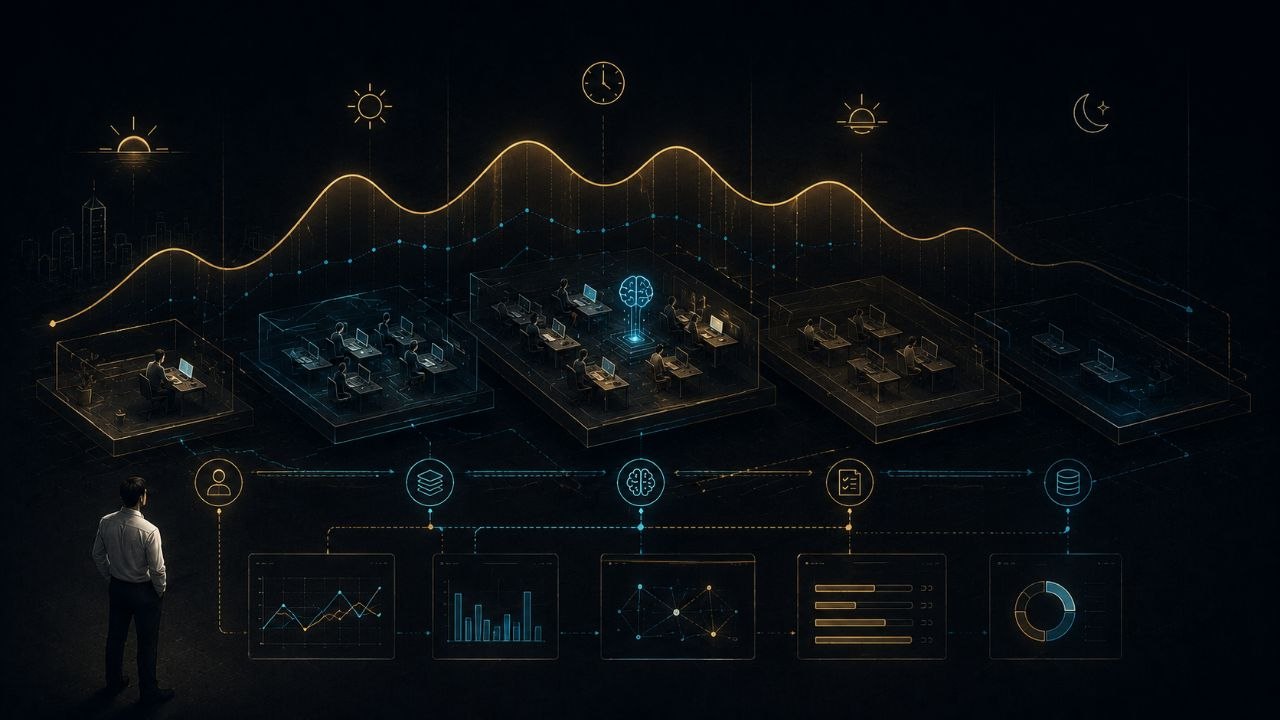
The main innovation is new telemetry that collects data continuously, not in weekly snapshots as before. This revealed what had been hidden: rhythms.
Let us start with the obvious. On weekends, people use Claude for work less often. The share of personal requests jumps from 35% to nearly 50%. This is expected. But here is what is not: when people do work with AI at night or on weekends, tasks shift toward higher-paying occupations. Marketers and programmers work outside regular hours more often than telemarketers and clerks. This is not about AI. It is about how the labor market works: the higher your income, the less your work is tied to nine to five.
The funny part is the hourly peaks. News at 7 a.m. Business correspondence at 10-11 a.m. Recipes at 6 p.m., 2.3 times more frequent than average. Sleep advice around 5 a.m. This is not economic analysis. It is an X-ray of everyday life. A company that owns this kind of telemetry knows more about the human day than any sociological study.
Next come numbers worth thinking about. The report introduced for the first time a classification of “artifacts,” what people take away from an AI session. 93% of conversations with Claude produce a tangible result. The most popular: explanations (17%), documents and reports (15%), guidance (11%). Code and technical work account for only a sixth.
And here is what matters: the more expensive the work, the more tokens it consumes. Marketers ($80/hour) spend 2.5 times more tokens than editors ($37/hour). This is not random. Higher-paying occupations produce more complex artifacts, and the model spends resources on them proportionally. Moreover, people do not step back: in expensive tasks, the user gives 1.53 times more commands, and Claude writes 1.34 times longer. Together, not instead.
The difference between Claude Code and regular chat deserves special attention. In Claude Code, users delegate far more to the model. An average blog-writing session in chat: 13 rounds of dialogue. In Claude Code: one human prompt. And it is not just that Claude Code uses more powerful models. Even on the same models, the autonomy level in code mode is 0.26 points higher. The product matters more than the model. This is a direct challenge to an entire industry obsessed with benchmark comparisons while forgetting about the interface.
A user survey (81,000 respondents in December, then another 9,700 in April) produced an unexpected result. Those who delegate the most tasks to Claude turned out to be the most optimistic about their future. They expect salary growth, job security, and meaningful work. The “AI makes you stupid” hypothesis is not confirmed: heavy delegators report learning at the same rate as everyone else. They simply see what the model can do, and this knowledge does not scare them; it arms them. The report authors honestly note that this is self-assessment, and skills may erode imperceptibly.
There is also a troubling signal. Only 12% of survey respondents are women. And they use Claude differently: more iterative dialogue, less automation, more “live” time in chat. Even controlling for occupation, the difference persists. This is either about access (women are less often in professions where Claude Code is adopted) or about different attitudes toward delegation. Either way, 12% is a reason to think about who exactly is shaping the future of the AI economy and whose needs are being considered.
Another subtle but telling detail from the report: a classifier determined that Claude’s reading level is almost always higher than the user’s prompt, by roughly one year of education. This sounds like praise, but it is actually a complex issue. When the model answers at a higher level than asked, it either expands the horizon or creates an unnecessary barrier. The gap is widest where the user describes something to be built: graphics (+2.6 years), games (+1.9), applications (+1.7). And smallest for audience-facing writing like blogs and emails. The model does not just answer; it pulls the response up to a level it considers correct. Sometimes this is help, sometimes paternalism.
The most human result of the survey is the final question: “What do you hope an economy shaped by AI looks like in ten years?” More than half of respondents mentioned collaboration. Work remaining meaningful, with AI taking the tedious part. Gains being widely shared. Not utopia, not dystopia. A normal, decent life where technology works for people, not the other way around.
This is the main takeaway from the report. People who interact with AI every day are not afraid of its power. They are afraid the power will not reach everyone.